Please ensure Javascript is enabled for purposes of website accessibility

What to Expect from an ABA Therapy Center in Muscatine, IA

Discover what an ABA therapy center in Muscatine, IA offers your child. Learn how BCBA-led programs support children with autism through evidence-based care.

June 22, 2026

Finding the right support for your child with autism spectrum disorder (ASD) means understanding what actually happens inside an ABA therapy center, not just what the name suggests. Many families in Muscatine arrive at their first consultation with questions and uncertainty about the process, the people, and what their child will experience week to week.

An ABA therapy center brings together Board Certified Behavior Analysts (BCBAs), Registered Behavior Technicians (RBTs), and structured learning environments designed around each child's individual goals. The experience is different from school, different from general counseling, and different from what most families expect before they begin.

This article breaks down what you will find when you connect with an ABA therapy center in Muscatine, how sessions are structured, what your child works toward, and what your role looks like as a caregiver.

What an ABA Therapy Center Actually Does

Applied Behavior Analysis is an evidence-based approach to supporting children with ASD by teaching skills and reducing behaviors that interfere with learning, communication, and daily functioning. An ABA therapy center delivers this support through individualized treatment plans developed and overseen by a BCBA.

The center model differs from in-home therapy in that it provides a structured, consistent environment outside the home where children work on skills that may be harder to target in a home setting, including group social interactions, classroom readiness, and peer communication.

At a center like A New Start ABA, children in Muscatine typically work on:

  • Communication skills, including requesting, labeling, and conversation
  • Social skills such as turn-taking, sharing, and reading social cues
  • Daily living and self-care routines
  • Academic readiness and pre-academic skills
  • Reducing behaviors that create barriers to learning or safety

Sessions are structured, data-driven, and adjusted regularly based on what the data shows about your child's progress.

How a BCBA Designs Your Child's Treatment Plan

Before therapy begins, a BCBA conducts an initial assessment. This is not a single appointment. It is a comprehensive process that includes standardized assessments, direct observation of your child, and a detailed interview with caregivers about the child's strengths, challenges, daily routines, and family priorities.

The assessment results become the foundation of a written treatment plan that identifies specific, measurable goals. Each goal is broken into teachable steps, and every session targets skills from that plan in a deliberate sequence.

According to the U.S. Centers for Disease Control and Prevention, early and intensive behavioral intervention produces the strongest outcomes for children with ASD. The individualized nature of the treatment plan is what makes intensity meaningful: your child is not working on generic skills, but on the specific behaviors and abilities that matter most for their development and daily life.

Source: https://www.cdc.gov/autism/treatment/index.html

Your BCBA reviews progress data regularly, at least monthly in most programs, and updates the treatment plan as your child meets goals or when the data shows that a strategy needs adjustment. This ongoing review is what keeps the program responsive to your child's actual progress rather than a fixed curriculum.

What Happens During an ABA Session

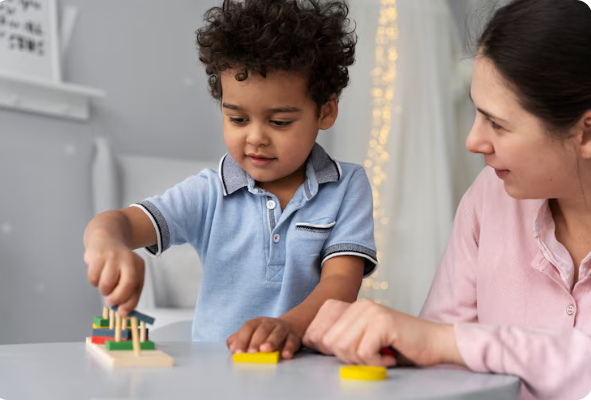
Each session at an ABA therapy center is led by an RBT under the supervision of a BCBA. The RBT works directly with your child, implementing the strategies and targets outlined in the treatment plan, while collecting data on every trial.

Sessions typically blend several types of activities:

Structured Teaching Trials

Discrete trial teaching (DTT) is a method where the therapist presents a clear instruction, your child responds, and the therapist delivers feedback or reinforcement. This approach is highly effective for teaching new skills systematically, particularly in communication and academic readiness areas.

Natural Environment Teaching

Not every skill is best taught at a table. Natural environment teaching (NET) embeds learning into play, routines, and everyday activities. A child working on requesting skills might practice during a preferred toy activity; a child working on following multi-step directions might practice during an art project.

Social Skills Practice

For children at centers rather than home programs, peer interaction is a significant advantage. Social skills groups allow children to practice turn-taking, conversation, and cooperative play with same-age peers in a structured, supported setting with an RBT facilitating the interactions.

How Progress Is Measured

Data collection is a defining feature of ABA and one of the things that sets it apart from other types of therapy. During every session, your child's RBT records data on each skill target: whether the response was correct, whether a prompt was needed, and what type. This creates a continuous record of your child's performance across every session.

Your BCBA uses that data to generate graphs that show trends over time. A skill showing consistent correct responses across multiple sessions signals mastery. A skill that plateaus or regresses signals that the teaching approach needs adjustment.

You will have regular opportunities to review this data with your child's BCBA, either at scheduled progress meetings or through parent training sessions. The data removes guesswork from the question of whether your child is making progress. It answers that question concretely, session by session.

What to Ask Before You Choose an ABA Therapy Center in Muscatine

Not all ABA programs operate the same way. Before committing to a center, there are a few questions that help you evaluate whether the program is a strong fit for your child.

Who supervises the RBTs?

Every ABA program should have a BCBA who reviews data, adjusts treatment plans, and supervises the RBTs working directly with your child. Ask how often the BCBA observes sessions and how supervision is documented.

How many hours per week is right for my child?

ABA intensity varies significantly depending on your child's age, diagnosis, and goals. Some children receive 10 hours per week; others receive 30 or more. Your BCBA should be able to explain the reasoning behind the recommended hours and how that recommendation connects to your child's specific treatment goals.

How is parent training handled?

A quality ABA therapy center integrates parent training into the program rather than treating it as optional. Ask how often parent training occurs, what it covers, and how the center supports caregivers in applying strategies between sessions.

How does the center communicate with families?

Expect clear, regular communication about your child's progress, schedule changes, and any concerns that arise during sessions. Ask how the center handles communication between sessions and what their process is if a concern comes up mid-program.

Insurance Coverage for ABA Therapy in Iowa

ABA therapy at a center in Muscatine is typically covered by most major insurance plans in Iowa, including Medicaid. Iowa law requires health insurance policies to cover ABA therapy for children diagnosed with ASD, which means most families can access center-based services without paying entirely out of pocket.

Source: https://www.autismspeaks.org/insurance-coverage-autism

A New Start ABA works with families to verify insurance coverage before services begin. Your BCBA's assessment and treatment plan are used as the basis for the authorization request, and the center's team can assist with the process of getting services approved.

If you are unsure whether your current plan covers ABA therapy services in Muscatine, contacting the center directly is the fastest way to get accurate information about your specific coverage.

Frequently Asked Questions

How long does it take to get started at an ABA therapy center in Muscatine?

The timeline depends on insurance authorization, scheduling availability, and the time needed to complete the initial assessment. Most families go through the assessment and begin services within four to eight weeks of initial contact, though this varies by program and insurance plan.

What age does ABA therapy serve at A New Start ABA?

ABA therapy is most commonly started in early childhood, and research supports early intensive intervention as producing the strongest outcomes. However, ABA is effective across a wide age range. Programs are tailored to the child's developmental level regardless of age.

Will my child be with other children or receive one-on-one therapy?

Most center programs include a mix of both. One-on-one sessions with an RBT allow intensive skill-building, while structured group activities provide opportunities to practice social and peer skills in a supported setting.

Can my child receive both center-based and in-home ABA therapy?

Yes. Some children benefit from a combination of settings. In-home ABA therapy targets skills in the natural home environment, while center-based services address goals better suited to a structured setting. Your BCBA can help determine the right combination for your child's needs.

What happens when my child meets all of their goals?

When your child meets the goals in their treatment plan, the BCBA updates the plan with new targets that reflect the next level of skill development. Over time, as your child's needs decrease, the intensity of services may be stepped down. The transition out of ABA therapy is a planned process, not an abrupt ending.

Finding the Right ABA Therapy Center for Your Child

An ABA therapy center in Muscatine provides a structured, data-driven environment where your child builds the communication, social, and daily living skills they need for a fuller, more independent life. The quality of the program comes down to the qualifications of the people running it, the rigor of the data practices, and the degree to which families are treated as partners in the process.

A New Start ABA serves families in Muscatine, Wilton, Durant, West Liberty, and surrounding Iowa communities with center-based and in-home ABA programs led by BCBAs. If you are ready to learn whether our program is the right fit for your child, contact the A New Start ABA team to speak with a BCBA directly.

Finding the right support for your child with autism spectrum disorder (ASD) means understanding what actually happens inside an ABA therapy center, not just what the name suggests. Many families in Muscatine arrive at their first consultation with questions and uncertainty about the process, the people, and what their child will experience week to week.

An ABA therapy center brings together Board Certified Behavior Analysts (BCBAs), Registered Behavior Technicians (RBTs), and structured learning environments designed around each child's individual goals. The experience is different from school, different from general counseling, and different from what most families expect before they begin.

This article breaks down what you will find when you connect with an ABA therapy center in Muscatine, how sessions are structured, what your child works toward, and what your role looks like as a caregiver.

What an ABA Therapy Center Actually Does

Applied Behavior Analysis is an evidence-based approach to supporting children with ASD by teaching skills and reducing behaviors that interfere with learning, communication, and daily functioning. An ABA therapy center delivers this support through individualized treatment plans developed and overseen by a BCBA.

The center model differs from in-home therapy in that it provides a structured, consistent environment outside the home where children work on skills that may be harder to target in a home setting, including group social interactions, classroom readiness, and peer communication.

At a center like A New Start ABA, children in Muscatine typically work on:

Sessions are structured, data-driven, and adjusted regularly based on what the data shows about your child's progress.

How a BCBA Designs Your Child's Treatment Plan

Before therapy begins, a BCBA conducts an initial assessment. This is not a single appointment. It is a comprehensive process that includes standardized assessments, direct observation of your child, and a detailed interview with caregivers about the child's strengths, challenges, daily routines, and family priorities.

The assessment results become the foundation of a written treatment plan that identifies specific, measurable goals. Each goal is broken into teachable steps, and every session targets skills from that plan in a deliberate sequence.

According to the U.S. Centers for Disease Control and Prevention, early and intensive behavioral intervention produces the strongest outcomes for children with ASD. The individualized nature of the treatment plan is what makes intensity meaningful: your child is not working on generic skills, but on the specific behaviors and abilities that matter most for their development and daily life.

Source: https://www.cdc.gov/autism/treatment/index.html

Your BCBA reviews progress data regularly, at least monthly in most programs, and updates the treatment plan as your child meets goals or when the data shows that a strategy needs adjustment. This ongoing review is what keeps the program responsive to your child's actual progress rather than a fixed curriculum.

What Happens During an ABA Session

Each session at an ABA therapy center is led by an RBT under the supervision of a BCBA. The RBT works directly with your child, implementing the strategies and targets outlined in the treatment plan, while collecting data on every trial.

Sessions typically blend several types of activities:

Structured Teaching Trials

Discrete trial teaching (DTT) is a method where the therapist presents a clear instruction, your child responds, and the therapist delivers feedback or reinforcement. This approach is highly effective for teaching new skills systematically, particularly in communication and academic readiness areas.

Natural Environment Teaching

Not every skill is best taught at a table. Natural environment teaching (NET) embeds learning into play, routines, and everyday activities. A child working on requesting skills might practice during a preferred toy activity; a child working on following multi-step directions might practice during an art project.

Social Skills Practice

For children at centers rather than home programs, peer interaction is a significant advantage. Social skills groups allow children to practice turn-taking, conversation, and cooperative play with same-age peers in a structured, supported setting with an RBT facilitating the interactions.

How Progress Is Measured

Data collection is a defining feature of ABA and one of the things that sets it apart from other types of therapy. During every session, your child's RBT records data on each skill target: whether the response was correct, whether a prompt was needed, and what type. This creates a continuous record of your child's performance across every session.

Your BCBA uses that data to generate graphs that show trends over time. A skill showing consistent correct responses across multiple sessions signals mastery. A skill that plateaus or regresses signals that the teaching approach needs adjustment.

You will have regular opportunities to review this data with your child's BCBA, either at scheduled progress meetings or through parent training sessions. The data removes guesswork from the question of whether your child is making progress. It answers that question concretely, session by session.

What to Ask Before You Choose an ABA Therapy Center in Muscatine

Not all ABA programs operate the same way. Before committing to a center, there are a few questions that help you evaluate whether the program is a strong fit for your child.

Who supervises the RBTs?

Every ABA program should have a BCBA who reviews data, adjusts treatment plans, and supervises the RBTs working directly with your child. Ask how often the BCBA observes sessions and how supervision is documented.

How many hours per week is right for my child?

ABA intensity varies significantly depending on your child's age, diagnosis, and goals. Some children receive 10 hours per week; others receive 30 or more. Your BCBA should be able to explain the reasoning behind the recommended hours and how that recommendation connects to your child's specific treatment goals.

How is parent training handled?

A quality ABA therapy center integrates parent training into the program rather than treating it as optional. Ask how often parent training occurs, what it covers, and how the center supports caregivers in applying strategies between sessions.

How does the center communicate with families?

Expect clear, regular communication about your child's progress, schedule changes, and any concerns that arise during sessions. Ask how the center handles communication between sessions and what their process is if a concern comes up mid-program.

Insurance Coverage for ABA Therapy in Iowa

ABA therapy at a center in Muscatine is typically covered by most major insurance plans in Iowa, including Medicaid. Iowa law requires health insurance policies to cover ABA therapy for children diagnosed with ASD, which means most families can access center-based services without paying entirely out of pocket.

Source: https://www.autismspeaks.org/insurance-coverage-autism

A New Start ABA works with families to verify insurance coverage before services begin. Your BCBA's assessment and treatment plan are used as the basis for the authorization request, and the center's team can assist with the process of getting services approved.

If you are unsure whether your current plan covers ABA therapy services in Muscatine, contacting the center directly is the fastest way to get accurate information about your specific coverage.

Frequently Asked Questions

How long does it take to get started at an ABA therapy center in Muscatine?

The timeline depends on insurance authorization, scheduling availability, and the time needed to complete the initial assessment. Most families go through the assessment and begin services within four to eight weeks of initial contact, though this varies by program and insurance plan.

What age does ABA therapy serve at A New Start ABA?

ABA therapy is most commonly started in early childhood, and research supports early intensive intervention as producing the strongest outcomes. However, ABA is effective across a wide age range. Programs are tailored to the child's developmental level regardless of age.

Will my child be with other children or receive one-on-one therapy?

Most center programs include a mix of both. One-on-one sessions with an RBT allow intensive skill-building, while structured group activities provide opportunities to practice social and peer skills in a supported setting.

Can my child receive both center-based and in-home ABA therapy?

Yes. Some children benefit from a combination of settings. In-home ABA therapy targets skills in the natural home environment, while center-based services address goals better suited to a structured setting. Your BCBA can help determine the right combination for your child's needs.

What happens when my child meets all of their goals?

When your child meets the goals in their treatment plan, the BCBA updates the plan with new targets that reflect the next level of skill development. Over time, as your child's needs decrease, the intensity of services may be stepped down. The transition out of ABA therapy is a planned process, not an abrupt ending.

Finding the Right ABA Therapy Center for Your Child

An ABA therapy center in Muscatine provides a structured, data-driven environment where your child builds the communication, social, and daily living skills they need for a fuller, more independent life. The quality of the program comes down to the qualifications of the people running it, the rigor of the data practices, and the degree to which families are treated as partners in the process.

A New Start ABA serves families in Muscatine, Wilton, Durant, West Liberty, and surrounding Iowa communities with center-based and in-home ABA programs led by BCBAs. If you are ready to learn whether our program is the right fit for your child, contact the A New Start ABA team to speak with a BCBA directly.